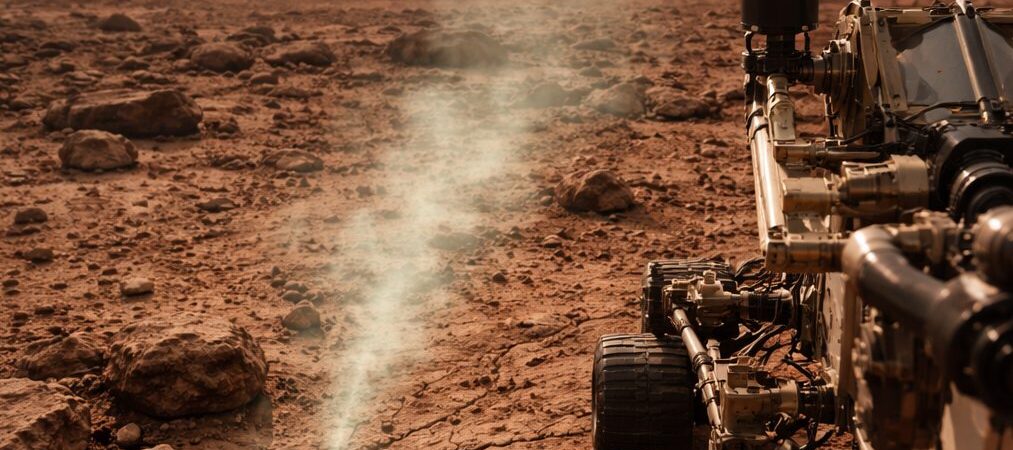
Recent explorations and studies of Mars have provided one of the most compelling pieces of data in recent years: the confirmation of methane on the Red Planet. This discovery has ignited a wave of excitement and speculation in the scientific community. The presence of methane could be a clue to understanding unprecedented aspects of Mars, either indicating potential biological activity or new kinds of geological processes.
What Methane Means for Mars
Methane is a gas that, on Earth, is largely produced by biological processes. Its presence on Mars raises the question: could there be life, or has there been life on Mars? The implications are enormous. However, researchers remain cautious. Methane can also be produced through non-biological processes, such as the result of interactions between water and rock under specific conditions.
The European Space Agency’s Mars Express orbiter and NASA’s Curiosity rover have both detected methane on Mars. Notably, the methane levels appear to vary with the Martian seasons, suggesting dynamic processes at play. The seasonal variation in methane concentrations hints at the complex and changing environment on Mars, which could be a result of subsurface microbial life or chemical reactions involving water.
Geological or Biological?
To unravel whether Mars’s methane is of biological or geological origin, scientists are examining the isotopic signatures of the gas. On Earth, biological methane has a distinctive isotopic ratio compared to geological methane. Instruments on upcoming missions are expected to provide more precise measurements, which could offer insight into this mystery. Understanding these ratios on Mars will bring us closer to discovering the source of the gas.

Additionally, the presence of certain minerals that form in water-rich environments on Mars adds to the argument of a potentially habitable past or present. These minerals could indicate that if life ever existed on Mars, there might still be some form of metabolic activity producing methane.
Challenges and Future Exploration
Nonetheless, detecting and analyzing methane on Mars poses significant challenges. The Martian atmosphere is thin, and methane has a short lifespan, making it difficult to detect and analyze from orbit. Earth-based telescopes have attempted to measure it, but the results have been inconsistent. This inconsistency highlights the need for advanced mission capabilities that can provide detailed molecular analysis directly from Mars.
Future missions to Mars, like the planned ExoMars rover and the Mars Sample Return mission, aim to collect samples for analysis on Earth. By bringing Martian soil and atmosphere samples back, scientists will have access to sophisticated laboratory equipment to search for signs of life or determine the geological processes at play.
The detection of methane on Mars stands as an invitation to deepen our understanding of the Red Planet. Whether the cause is biological, geological, or a combination of both, it is clear that Mars has a dynamic environment, rich in potential for discovery. The slow, methodical journey to uncover the source of Martian methane continues to offer tantalizing possibilities for what lies beneath its surface.
In summary, methane on Mars embodies both the hope and caution of planetary exploration. As scientists refine their techniques and missions enhance their capabilities, the mystery of Martian methane brings us closer to answering the age-old question of whether we are alone in the universe.